
Here are some of my favorite and probably the best Plugin Alliance Plugins for mixing and mastering to add to your arsenal!
When it comes to choosing audio plugins that truly deliver, I’ve found that Plugin Alliance offers one of the most compelling toolkits out there. I love how their catalogue mixes vintage-inspired emulation and cutting-edge creative effects, giving me both familiar warmth and fresh sonic possibilities. Instead of feeling like just another plugin house, they’ve built something that feels like a hive of trusted brands and inventive developers working together.
Plugin Alliance is a plugin aggregator and subscription-based marketplace that rents out and sells virtual audio plugins from some of the world’s top developers. It’s operated by Plugin Alliance LLC, based in Wilmington, Delaware, with its headquarters in Santa Cruz, California.
What makes it truly special is that its lineup hosts brands like Brainworx, AMEK, Black Box Analog Design, Lindell Audio, SPL, Mäag, and Bettermaker, among many others. In other words, it’s a curated ecosystem of some of the biggest and best audio plugin companies working together.
Their subscription plans start at $14.99 per month or $149.99 for the Core pack and go up to $29.99 per month or $249.99 per year for the Pro pack, offering access to hundreds of premium plugins.
For 2026, I’ve picked out 12 of the best plugins on Plugin Alliance that I keep reaching for. These are the ones that shine in real-world use, where I reach for them almost instinctively. Let’s check them out!
1. Shadow Hills OptoMax

I’ll start with the Shadow Hills OptoMax, a VST that doesn’t just recreate the legendary Mastering Compressor, as it completely reinvents it.
Built with Brainworx, Shadow Hills OptoMax focuses on the optical section of the original hardware but turns it into a modern, flexible tool that feels both vintage and fresh. It has that unmistakable “optical smoothness” I’m obsessed with, but with digital precision that lets me take it places hardware never could. S
I appreciate how intuitive it is; I can jump between shaping tone, compression, and drive without breaking creative flow. It’s one of those plugins that makes me want to keep tweaking just because it sounds so good at every step.
- Expanded Control
The Ratio and Speed settings (Slow, Med, Fast) might look simple, but they’re deceptively powerful. I often start in Slow mode for silky, musical levelling, perfect on vocals or guitars, then switch to Fast for punchier, more aggressive movement.
- Push Mode
This is where OptoMax gets wild. Push Mode gives you limiter-style speed for instant attitude. It’s killer on drum buses or modern vocals, especially when I blend it in parallel. You get punch, grit, and energy without flattening the mix, it’s one of my favorite tricks for bringing a track forward.
- Signature Transformer Colour
The ability to flip between Nickel, Iron, and Steel transformers is pure joy. Nickel feels hi-fi and smooth, Iron gives midrange warmth, and Steel adds bold harmonics. With TX Drive and Headroom, I can fine-tune how much analog flavor I want from clean and classy to gritty and vintage.
OptoMax also packs Tone, Air, and Smooth options that help me sweeten the top end or tame harshness, plus advanced sidechain controls that make it easy to fit into any workflow. It’s become one of those plugins I reach for instinctively, smooth when I need it, aggressive when I want it.
Shadow Hills OptoMax comes in VST2, VST3, AU, and AAX formats for macOS and Windows users.
2. Lindel Audio EQ825
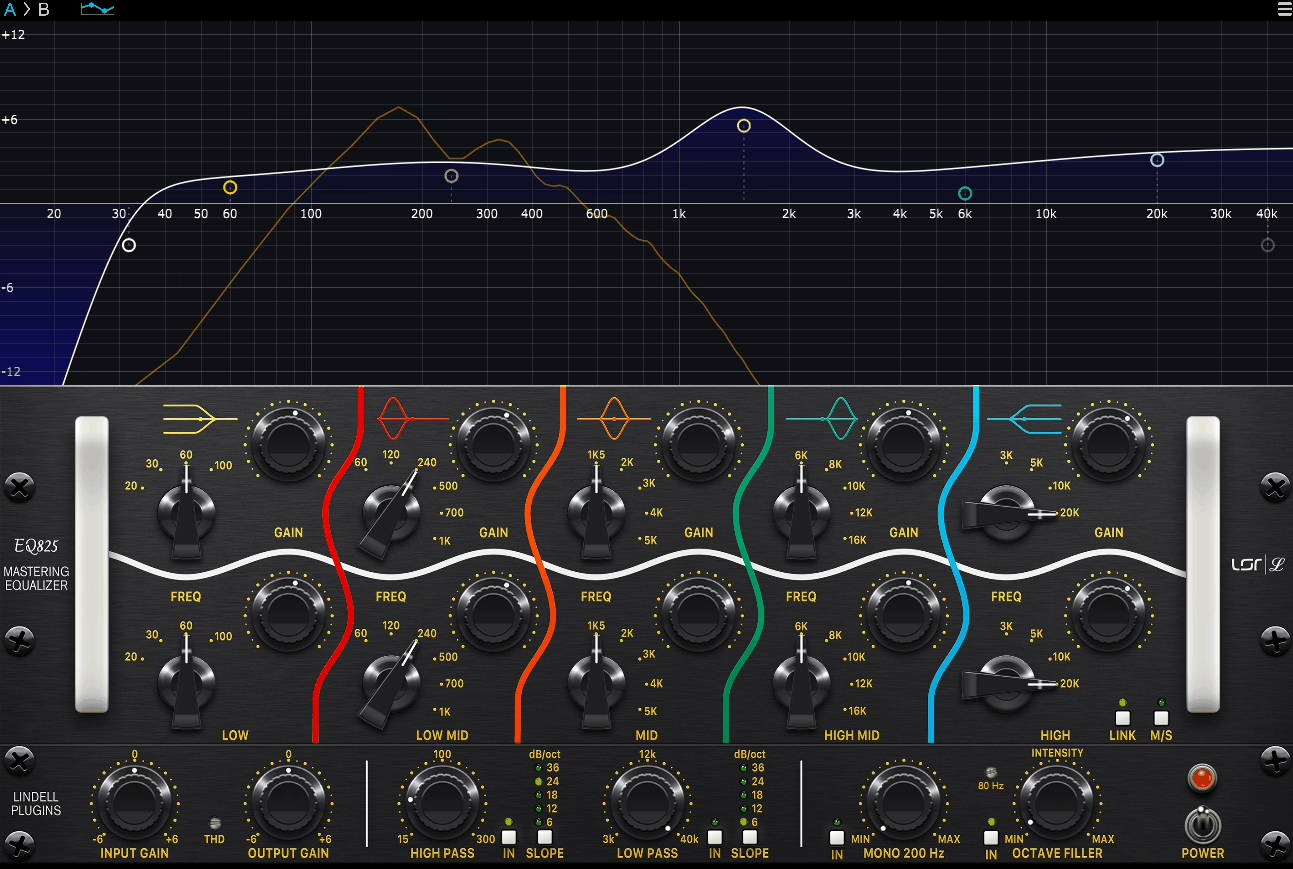
What makes the Lindell Audio EQ825 truly special is that it captures one of the rarest and most revered mastering EQs ever built, a piece of analog history most of us will never even see in person.
I love how Lindell didn’t just model another classic EQ; they went after an ultra-exclusive, inductor-based tube design worth over $20,000 in hardware form, and somehow bottled its creamy, golden tone inside a plugin. EQ825 is the kind of EQ that makes everything sound expensive, warm, wide, and beautifully balanced.
- Smooth Tubes and Transformers
At the heart of the EQ825’s sound are its Class-A tube stages and transformer-balanced circuitry, which bring a sweetness and depth that’s instantly noticeable.
The tone is round, open, and harmonically rich, which is the kind of analog glue that pulls a mix together without clouding it. When I want a touch more bite or saturation, I’ll turn up the Variable THD control, and it just blooms into subtle, velvety grit.
- Five-Band Parametric Power
The 5 EQ bands cover everything from deep lows to airy highs with incredible musicality. Each band is sculpted using custom-modeled inductors and resistors, so even broad moves sound natural and classy.
I find it brilliant for mix bus shaping and mastering, especially when I want to enhance dimension without over-processing. It feels like painting with tone rather than tweaking frequencies.
- Modern Additions
Features like Mid/Side processing, Mono Maker, and Octave Filler expand its range far beyond what the original could do. The Octave Filler, in particular, is magic on kicks, bass, and 808s, adding weight and presence without muddying the mix.
Add in up to 16x oversampling and FFT spectrum analysis, and you’ve got a mastering EQ that’s as powerful as it is musical.
For me, the EQ825 is that rare kind of plugin that feels more like an instrument than a utility. It’s smooth, classy, and endlessly musical, great for final mixes, acoustic mastering, or anything that deserves extra polish.
Lindell Audio EQ825 comes in VST2, VST3, AU, and AAX formats for macOS and Windows users.
3. Black Box Analog Design HG-Q

The Black Box Analog Design HG-Q feels like a breakthrough in EQ design, a plugin that reimagines how EQ can sound and respond.
I really like the fact that HG-Q boosts run through valves while cuts use clean solid-state circuits is pure genius, it lets me shape tone with depth and character while keeping the clarity today’s mixes demand. It’s more than EQ; it’s tone sculpting at its finest.
The interface strikes a perfect balance between vintage vibe and modern usability. Its 3-band design with independent boost and cut feels intuitive, and the built-in spectrum analyzer gives a clear view of how those two circuits interact.
- Dual Personality EQ Design
Each of the 6 bands behaves differently depending on whether you’re boosting or cutting. The tube-driven boosts add creamy harmonic content that glues elements together, while the solid-state cuts stay pure and transparent.
It’s like having two EQ philosophies in one tool. I often use it to open up a vocal’s top end with warm saturation while carving out muddy lows with surgical precision.
- 2X Mode and Saturation Control
The 2X mode doubles the available gain range to 16 dB, unlocking rich harmonic density and deeper tone shaping.
With the variable Sat control, you can push the HG-Q from subtle enhancement to bold, analog-style grit. I love how it enhances mix density and brings out lower-level detail without ever sounding harsh.
- Creative Topology and Workflow
Being able to switch each band between series and parallel operation is what really sets this EQ apart. The way bands interact creates complex phase relationships and dynamic tonal shifts that feel alive.
The auto-listen and visual dependency curve features make it easy to fine-tune these interactions, turning EQing into a genuinely creative process.
The HG-Q might look like an EQ, but it feels more like an instrument for tone sculpting. For me, it’s become a go-to when I need something musical, modern, and just a bit unpredictable, in the best way possible.
Black Box Analog Design HG-Q comes in VST2, VST3, AU, and AAX formats for macOS and Windows users.
4. TBT Kirchhoff-EQ

The Kirchhoff EQ doesn’t settle for being another “clean digital EQ”, cause it’s a full-spectrum tone-sculpting environment that combines precision, flexibility, and warmth in a way few others do.
Developed by Three Body Technology, Kirchhoff-EQ is built around a robust DSP framework that feels almost limitless: 32 bands, 15 filter types, 9 modeled vintage EQs, and advanced dynamic behavior. It’s as if FabFilter Pro-Q and DMG Equilibrium had a hyper-detailed, technically gifted child.
The interface is sleek, resizable, and deeply interactive. It’s easy to create complex EQ structures visually, with smooth curves that respond musically no matter how extreme your settings.
- Dynamic EQ with Two-Way Thresholds
What sets Kirchhoff apart is its dynamic processing system. Each band can act as a compressor or expander above and below the threshold, letting you control both peaks and valleys.
I often use this for taming vocal harshness while simultaneously lifting air frequencies, all in one band. It’s powerful, transparent, and a huge time-saver.
- Filter Powerhouse
The EQ’s 15 unique filter shapes, including Bell, Sword, Brickwall, and Tilt are continuously variable from gentle 6 dB slopes up to razor-sharp 96 dB/oct. The Robust Nyquist-Matched Transform keeps curves analog-smooth even at high frequencies, avoiding the “digital cramping” many EQs suffer from. It’s an engineer’s dream for precision without sterility.
- Vintage Character Meets Modern Clarity
I love the inclusion of nine modeled analog EQ types, from British consoles to Pultec-style tubes. Combined with switchable Zero-Latency, Analog, Linear, and Mixed Phase modes, you can blend classic tone with pristine modern behavior.
For me, Kirchhoff EQ is the rare mix of science and soul, it can sound as transparent or as colorful as you want, and it feels incredibly refined. It’s become my go-to for mastering and detailed vocal work, where nuance truly matters.
Three Body Technology Kirchhoff EQ comes in VST3, AU, and AAX formats for macOS and Windows users.
5. bx_console AMEK 200

Inspired by the GML 8900, a holy-grail unit rarely modeled in plugin form, AMEK Mastering Compressor captures that transparent, classy control while giving you far more insight and shaping power.
It’s one of those rare tools that can glue, polish, and open a mix without leaving fingerprints on the sound.
The interface feels refined and serious, a classic Brainworx design that’s both elegant and surgical. I appreciate the detailed metering and Detector Activity Monitor, which visualizes how the three detection circuits (Slow, Fast, and Peak) respond to the signal.
It gives you a deeper understanding of how the compressor breathes with your track. Add in the Sidechain Filter Module, TMT channel modeling, and Mid/Side workflow, and you get a mastering-grade experience that feels fluid and intuitive.
- Triple Detector System
This is where the AMEK Mastering Compressor truly shines. Each channel has three RMS detectors (Slow, Fast, and Peak), each tuned for different time responses.
By balancing their influence, you can dial in incredibly nuanced compression behavior, from smooth leveling to precise transient shaping. It’s like having a DBX 165A, LA-2A, and 1176 fused into one unit, all playing off each other.
- Flexible Knee & Ratio Design
You can switch between soft knee for natural, musical movement and hard knee for assertive control. I often use soft knee for mastering work, it gives that transparent, “finished” feel, and hard knee when I want to push drums or vocals forward.
The range runs from 1.1:1 all the way up to brickwall limiting, so it can be as gentle or aggressive as you need.
The built-in EQ and filter modules let you fine-tune frequency response right inside the compressor, a huge time-saver for mastering chains.
For me, this is one of the most transparent yet powerful compressors I’ve ever used. It adds cohesion and polish without ever feeling heavy-handed, that rare blend of control and elegance. Pricey? Sure. But it genuinely delivers mastering-level refinement that feels worth every cent.
Brainworx AMEK Mastering Compressor comes in VST2, VST3, AU, and AAX formats for macOS and Windows users.
6. Knif Audio Knifonium

Just when you think every great analog synth has already been cloned in plugin form, Knif Audio’s Knifonium arrives to prove there’s still magic left to capture.
Knifonium is a faithful recreation of a handmade, 26-tube monophonic beast that costs as much as a small car. I like how it manages to feel alive: unpredictable, warm, and full of subtle imperfections that only real tubes could produce. It’s part instrument, part attitude and it oozes vintage character from the first note.
The interface looks like something out of a 1970s laboratory, but the workflow is pure Brainworx polish. Everything is laid out logically with two VCOs, a ladder filter, ring modulator, sample & hold, and envelopes that can stretch from snappy percussion to long evolving drones.
- Tube Saturation & Distortion Modes
The heart of Knifonium’s sound lies in its 26 vacuum tubes, modeled with Brainworx’s TMT (Tolerance Modeling Technology). The result is stunning, every note feels rich and dimensional.
The Amp Mode offers Triode, Pentode, and Saturated distortion types, each adding their own shade of grit. I rarely use it “clean” because even subtle drive settings give me that lush analog warmth plugins usually fake.
- Filter & Modulation Powerhouse
The Moog-style ladder filter is pure butter, smooth, self-oscillating, and perfect for sculpting bass and leads.
What I love most is how much modulation depth this synth packs in: envelopes, LFO symmetry, frequency modulation, feedback routing, and even external modulation sources. It’s insanely flexible yet always musical, from deep techno growls to haunting, cinematic tones.
- Stereo Tricks & Modern Touches
Brainworx added thoughtful extras like stereo width per oscillator, mid/side filtering, and built-in high-end effects (delay, reverb, chorus, phaser, EQ, and the Mäag Air Band).
There’s even the Metal666 amp sim and a Wavefolder if you want to push it into brutal territory. Paired with its powerful arpeggiator, it goes from vintage Moog-style funk to wide, modern electronic textures with ease.
Sure, it’s CPU-hungry and not cheap, but every time I play it, I’m reminded why analog obsession exists in the first place.
Knif Audio Knifonium comes in VST2, VST3, AU, and AAX formats for macOS and Windows users.
7. Swivel Audio HitStrip

Every once in a while, a channel strip plugin comes along that genuinely changes how fast I can work, and Swivel’s HitStrip is exactly that.
The star here for me is how it takes the best elements of EQ, dynamics, de-essing, transient shaping, harmonic enhancement, stereo control, and limiting, and merges them into one clean, modern window.
HitStrip is not pretending to be analog or vintage; instead, it’s proudly digital, focused on speed, flexibility, and intuitive control. Whether I’m mixing vocals, tightening a drum bus, or cleaning up a full mix, HitStrip gives me everything I need right where I need it.
The main EQ display acts as the visual hub for almost every processor, it’s where EQ curves, filters, de-esser bands, and transient shaping frequencies all come to life.
- EQ That Does It All
The 24-band EQ is the heart of HitStrip, and it’s loaded with features. Every band can be a bell, shelf, tilt, pass, or notch, with slopes up to 96 dB/oct, on any filter type.
You can EQ left/right or mid/side independently, solo individual bands, and even use a built-in virtual keyboard to target fundamental notes with a click. It’s one of the most musical and flexible EQs I’ve used in a channel strip.
- Smart Dynamics & Pulse-Driven Compression
The Dynamics section can be a compressor or expander and features a powerful side-chain system. You can trigger it from the source, an external signal, or even a tempo-synced pulse for instant rhythmic pumping, no routing headaches.
The Gate and Limiter are also excellent, each with clear metering and fast response, making it easy to control peaks and cleanup noise directly inside the plugin.
- Creative Tools: De-esser, Exciter, Transients
The De-esser behaves like a dynamic EQ band, perfect for vocals or harsh cymbals. The Exciter adds harmonic richness across low and high bands, visualized as a heat map, while the Transients module gives per-band control over attack and sustain, ideal for drums or plucky synths.
Add the Width, Color (saturation), and mono/side solo options in the master section, and HitStrip becomes a true one-stop shop for both corrective and creative processing.
After spending time with it, I can say HitStrip nails what many channel strips miss: clarity, speed, and cohesion. It lets me focus on the mix, not the chain. Everything’s right there, no plugin juggling, no scrolling, no second-guessing.
Swivel Audio HitStrip comes in VST3, AU, and AAX formats for macOS and Windows users.
8. Ampeg B-15N

Few amps have shaped the sound of modern bass quite like the Ampeg B-15N. I love how this plugin captures that unmistakable, thick, soulful tone that defined records from Motown to Memphis.
Whether it’s James Jamerson’s smooth low end or Duck Dunn’s punchy groove, the B-15N has always been the sound of electric bass. Brainworx has recreated it in stunning detail, giving us the warmth, depth, and musical grit of the original tube circuit right inside a DAW, no rattling cabinets required.
The interface is everything you’d want from a vintage emulation: simple, intuitive, and rich with analog flavor. The amp section lets you toggle between 1964 and 1966 circuit models, both faithfully modeled from Ampeg’s limited-edition Heritage B-15,N and the results are instant vibe.
- Two Classic Circuits in One
The 1964 circuit delivers a creamy, cathode-biased tone with that natural tube sag and warmth. Switch to 1966 for a fixed-bias circuit that’s louder, snappier, and more defined in the midrange. I love blending between them depending on the track, soft for smooth fingerstyle, sharp for driven pick tones.
- Authentic Baxandall EQ
The EQ section uses the same Baxandall bass and treble curves as the original amp, meaning every knob move sounds musical. Boosting lows feels like inflating the sound with air, not mud. The highs shimmer smoothly, never brittle, just pure, tube-driven polish.
- Brainworx FX Rack & Cabinet Chains
The built-in Brainworx FX rack is the perfect modern upgrade. With noise gate, Power Soak, tight/smooth filters, and pre/post HP/LP filtering, you can fine-tune every nuance.
The included 42 recording chains, captured through real cabinets and mics in a Neve-equipped studio, make it easy to go from studio clean to vintage growl in seconds.
What I enjoy most about the B-15N is how it makes every bass sound finished. It adds instant weight, warmth, and attitude, the kind of tone that fills a mix without fighting for space.
Ampeg B-15N comes in VST2, VST3, AU, and AAX formats for macOS and Windows users.
9. Unfiltered Audio TAILS

Every now and then, a plugin comes along that feels like it’s actually doing something new, and TAILS is exactly that.
I chose TAILS cause it is all about intelligent harmonic control. Thanks to its polytonal dual-buffer engine, it “listens” to your audio in real time, instantly resetting its buffer whenever a new transient or note hits. The result? Decays that bloom beautifully without clashing or turning to mush.
I particularly love how the ducking is automatic and musical; it’s like having an engineer constantly cleaning up your reverb tails in real time. Add to that MIDI control for muting, modulation, and pitch-shifting the tail buffer, and you’ve got a reverb that’s as much a performance instrument as a mix tool.
- Polytonal Dual Buffer Magic
The core of TAILS lies in its dual-buffer system, which separates old and new audio in the most musical way imaginable.
When a transient or chord change occurs, the first buffer instantly ducks while the second blooms into the new sound. It’s subtle, but the difference is huge; reverb tails remain harmonically pure and dynamically controlled, without overlapping dissonance.
I’ve used it on pianos, vocals, and pads, and it consistently produces a lush, cinematic space that never gets cluttered.
- Four Distinct Reverb Modes
TAILS includes DEEP, RENOUN, SPATIAL, and SHIMMER modes, each with its own personality. DEEP is rich and dark, RENOUN has that smooth studio depth, SPATIAL is wide and atmospheric, and SHIMMER (tuned by BT himself) adds ethereal, octave-shifted brightness.
- Clean, Creative, and CPU-Friendly
Even with all that power, TAILS barely touches your CPU, less than 1% on my M1 MacBook Pro. The auto-ducking, tone shaping, and randomization functions make it incredibly flexible for both sound design and mixing.
And with its advanced MIDI mapping, you can transform the reverb in real time, muting tails rhythmically or morphing between shimmered textures during a live performance.
Unfiltered Audio TAILS comes in VST3, AU, and AAX formats for macOS and Windows users.
10. bx_console SSL 4000 E

The bx_console SSL 4000 E is one of those plugins that instantly gives your mixes that real desk feel.
SSL 4000 E recreates the tone and layout of a true SSL 4K E console, complete with all the quirks, grit, and punch that made the original legendary.
Developed by Brainworx and officially licensed by Solid State Logic, it’s a full channel strip with EQ, dynamics, filters, gate, and more, all powered by TMT (Tolerance Modeling Technology) so each channel feels slightly different, just like analog hardware.
- E vs G Compression Flavors
The E-type compressor delivers smooth, dark control, great for bass or vocals. Flip to G-type for more punch and presence, perfect for drums and guitars. The built-in Fast Attack switch and wet/dry blend make it versatile and musical.
- Brown & Black EQ Models
Choose between the Black EQ’s aggressive, modern tone or the Brown EQ’s smoother vintage curves. Each band can toggle between bell and shelf shapes, and you can switch the EQ pre/post dynamics, offering flexibility depending on your workflow.
- Analog Mojo with TMT and THD
Brainworx’s Tolerance Modeling Technology makes every channel slightly different, subtle variations that add real analog width and life. Add V-Gain for console noise and THD for harmonic color, and suddenly your in-the-box mix feels like it’s running through 72 channels of real SSL gear.
The bx_console SSL 4000 E is clean when you want it, colorful when you push it, and surprisingly versatile. It’s one of those rare channel strips that fits anywhere, from a vocal chain to a drum bus, while keeping that unmistakable SSL energy intact.
Brainworx bx_console SSL 4000 E comes in VST2, VST3, AU, and AAX formats for macOS and Windows users.
11. HUM LAAL

LAAL is a fully analog limiter that somehow achieves true look-ahead processing without ever touching digital.
This unit uses a chain of all-pass filters to delay the signal by a mere 0.2 milliseconds, giving the limiter time to anticipate peaks before they hit. The result is uncanny: ultra-fast, transparent limiting that feels alive, not algorithmic.
I like how LAAL looks and feels like high-end precision engineering; solid, heavy, and purposeful. Its mirror-image channels ensure perfect stereo balance, and every control is stepped for recall, just as any mastering engineer would demand.
- Analog Look-Ahead Magic
That microscopic delay line lets the limiter act before a transient lands, maintaining punch and clarity without clipping. It’s clean, immediate, and almost impossible to distort.
- Dynamic Transient Mode
This ingenious circuit restores brilliance lost to heavy limiting, adding a smooth high-frequency lift that breathes life back into dense masters.
- Transformer Tone & Stereo Width
Engage the transformer path for subtle harmonic weight, or open the mix up with the Stereo Width control that expands the image while keeping the low end anchored.
Even when pushed, the LAAL stays invisible, everything just sounds tighter, wider, and more finished. It’s the kind of mastering limiter that doesn’t show off; it simply makes everything sound right for me.
The HUM Audio LAAL is a handcrafted analog mastering limiter with balanced XLR I/O, designed for precision use in high-end mastering studios.
12. SPL BiG
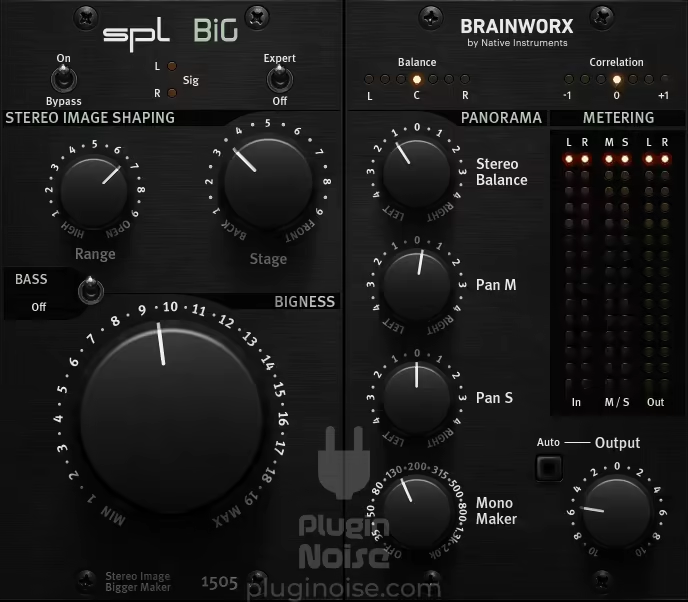
Originally a 500-series hardware module, BIG, the stereo enhancer has been faithfully modeled in software as it was in analog form.
I enjoyed how it turns a risky process like stereo widening into something effortless and natural. There’s no phase smear or harshness, just width and depth that sound classy and controlled.
What makes BiG so appealing is its elegance. You only get 3 main knobs: Range, Stage, and Bigness, plus two switches, but each one feels powerful.
The Range control defines which frequencies are affected, Stage adjusts how the width is distributed across the spectrum, and Bigness blends the processed signal back in for the perfect balance. With just a few turns, you can add gentle space to vocals or make a full mix sound huge and immersive.
- Smart Stereo Enhancement
BiG’s unique phase-safe filter network avoids the usual pitfalls of stereo widening. You get a stable, punchy image that stays rock solid in mono and full of life in stereo.
- Bass Boost and Depth
The Bass switch engages a subtle low-end lift borrowed from SPL’s AirBass circuit in the IRON Mastering Compressor. It gives the mix a bit of warmth and bottom-end power without clouding the mids.
- Expert Mode for Precision
Clicking the Expert switch reveals digital-only tools such as pan controls, auto gain compensation, Mid/Side metering, and the ability to solo Mid or Side channels. It adds surgical flexibility to an otherwise analog-feeling workflow.
SPL BiG is one of those plugins that makes an immediate difference. Whether you want to give a vocal mix more sparkle or open up a dense master, it delivers width that feels rich and natural, never forced. It’s simple, musical, and incredibly effective.
SPL BiG comes in VST2, VST3, AU, and AAX formats for macOS and Windows users.
Extra: Brainworx Mäag Audio EQ4

Few EQs have achieved the cult status of the Mäag Audio EQ4, and there’s a reason it’s been heard on everything from Celine Dion’s soaring vocals to the punchy mixes of the Black Eyed Peas.
Well, EQ4 does more than balance the audio; it sweetens it. This is the EQ that top-tier mixers reach for when they want silky highs, clean lows, and that unmistakable “air” that seems to lift a mix right off the speakers.
The 2024 update refines the experience even further with a sleeker black interface, resizable GUI, and new usability features like Undo/Redo and bank selection.
Despite the modern polish, the heart of the EQ4 remains classic Mäag with 5 fixed frequency bands and the legendary AIR BAND, a high-shelf circuit capable of enhancing presence without harshness.
- The Legendary AIR BAND
The EQ4’s defining feature, the AIR BAND, can boost at 2.5, 5, 10, 20, or 40 kHz, adding that open, polished sheen you hear on hit records. It’s perfect for vocals, acoustic guitars, or even a full mix that needs a lift without sounding brittle.
- SUB BAND for Weight and Warmth
On the other end, the SUB BAND (centered at 10Hz) lets you tighten or enhance the low-end foundation. It’s incredibly powerful on bass, kick, or mix bus, giving depth and impact while keeping the lows clean.
- Enhanced Plugin Features
The plugin version goes beyond the original hardware. The LEVEL TRIM control lets you manage overall gain, while detented knobs ensure precise, recallable adjustments. You can even ALT-click to toggle bands on and off for quick A/B comparisons, a small but brilliant workflow touch.
The Mäag EQ4 is not a surgical EQ; it’s a musical one. It keeps your mix’s character intact while adding clarity, weight, and air in ways that feel organic and effortless.
Mäag Audio EQ4 comes in VST2, VST3, AU, and AAX formats for macOS and Windows users.
Last Words
From analog giants to modern DSP marvels, Plugin Alliance continues to prove why it’s one of the most trusted names in audio.
Every plugin in this collection carries the soul of real hardware with the precision and flexibility of digital design. Whether you’re chasing vintage color, pristine mastering tools, or bold creative effects, these twelve standouts and the extra show just how powerful and musical the Plugin Alliance ecosystem has become.
