
Preamp plugins are crucial tools for shaping the tone and character of your recordings.
Whether you’re playing guitar, bass, or vocals, you will need a good-quality preamp to have that warmth, depth, and detail in your tone, which can transform your sound from dull to dynamic.
When choosing a preamp plugin, it is highly important to go for whichever best suits your workflow and musical needs. Some features you have to look for are versatility, ease of use, a faithful emulation of classic hardware if you like the analog vibes, and extra features like EQ or compression. Remember that some units focus on subtle harmonic saturation and warmth, while others are more suited for more aggressive character shaping and coloration.
I have to add that you also have to consider the use cases, as recording for guitar, bass, vocals, or other instruments may require different features. Versatility, low CPU use, and user-friendly interface are all important details besides the necessities like the clarity, depth, and presence the VST hast to deliver in terms of sound.
But the question is, with so many choices today, how can you be sure to choose the right one that goes well with your needs and workflow? That is why today we will sail in the sea of top-tier preamp plugins designed to enhance your recordings. From faithful analog emulations to modern digital innovations, there is a preamp VST for everyone here to create recordings with vintage vibes or pristine clarity. Let’s start our journey!
1. UAD Helios Type 69 EQ and PreAmp

The first suspect on the list, Helios Type 69 EQ and PreAmp, is designed to revive the tones of the iconic Helios consoles, famous for their key roles in rock and reggae history with artists from Led Zeppelin to Bob Marley. I love that the preamp offers more than just EQ with its great emulation of the transformer-driven warmth and the unique tonal character of the inductor-based filters.
As a fan of the 70s classic and hard rock sound, I love this plugin and how it adds the vintage rock vibe to the recordings. It works great with guitars, bass, and vocals, thanks to its rich, vintage color, which is ideal for adding weight and presence to the mixes.
The key features here, in my opinion, are that the unit has almost zero-latency monitoring, accurate impedance matching, and gain staging for mimicking the behavior of the original hardware.
The EQ section is handy with its musical control with bass, midrange, and high-frequency adjustment options. I gotta say the EQ is more about tonal enhancement rather than surgical precision. If you want to add some punch to kick drums and bass guitars, it offers the peaking bass EQ, which works great without making the low-end muddy, while the high shelf is excellent for providing a touch of air and brilliance.
The plugin is designed for Universal Audio’s Unison technology and Apollo users, but non-Apollo users can also benefit from it as it is a good mixing tool. I recommend gently overdriving the sound to get that analog warmth and smoothness.
As I mentioned before, the EQ controls can feel a bit limited as it is not meant for precision; the plugin’s overall tonal depth and vintage character are highly valuable to me. Its faithful recreation, pretty flexibility, and easy use make it stand out as a great unit for reaching analog sound.
Helios Type 69 EQ and PreAmp come in AAX, VST3, and AU (Mac only) formats for macOS 10.15 Catalina or newer and Windows 10 and 11.
2. Slate Digital FG-76 2

Modeled after a classic tube preamp famous for its warm and rich tones, FG-76 recreates the vintage tube circuitry from subtle colors to full-on saturated tones. Adding that distinctive character to your tone it helps your guitars, vocals, or bass to sit beautifully in the mix.
When I tried the FG-76, I found out that it is a highly straightforward unit with its control unit following the steps of its hardware counterpart. It only has three knobs with the Virtual Drive, my favorite control, in the centerpiece, pushing the preamp for increased saturation without affecting the output levels for a thick and harmonically rich tone.
The Trim control, on the other hand, is for output gain control, and the Phase Reverse switch adds more versatility in signal flow. The LED indicator on the top for visual feedback on the saturation levels is also a nice touch to keep track of your settings and sound. Overall, I really like the simplicity here.
In practice, the plugin is pretty successful in adding depth and presence to instruments. I would rather use this one on guitar and bass instead of vocals, as it really enhances that low-end warmth and adds a subtle glue to the tone. Its bold and slightly gritty sound is great for creating a thick and vintage tone, and Virtual Drive is there for you to find the sweet spot for each track as you can craft your tone, stopping anywhere in the middle from subtle warmth to high distortion.
I think this is a pretty cool plug-in, especially for guitars and bass, to have the tube preamp tones in your recordings. There are some minor issues, like the iLok installation hassle and the price tag, but you get two analog preamps in the Slate Digital Virtual Amp collection for the price offered.
As the other one in the offer, FG-73 is also a pretty good plugin with a basic interface; I think it is a good overall deal, with FG-76 and its authenticity and flexibility, elevating digital recordings with analog charm.
FG-76 comes in AAX, VST2, VST3, and AU (Mac only) formats for macOS 10.15 Catalina or newer and Windows 10 and 11.
3. Efektor Gainia HB

Gainia HB offers a user-friendly digital experience while successfully capturing the essence of analog gear to recreate the sound of classic preamps in your DAW for a highly affordable price. It provides rich and vintage overdrive tones that can be warm, dynamic, and packed with sustain to help you create creamy leads or crunchy rhythms.
Gainia HB has a good balance of control and ease of use thanks to its sleek interface and minimalistic design. It comes with gain, tone, and volume controls, giving guitarists the flexibility to shape their sound, and the resizable GUI makes it adaptable to any workflow. Another handy feature I liked is the up to 8x oversampling and da ry-wet mix knob for higher sound quality and creative control over the tone.
OK, it is pretty standard until now, but what really grabbed my attention was this unit’s compatibility with the free Pillar Power Amp Simulator, which is excellent at resolving the dynamic response of true tube power amps. When you pair these two tools, you get a pretty fantastic combination for crafting studio-quality guitar tones with a great analog flavor for less than 10 bucks.
I recommend using this plugin mainly with guitars as it is mainly designed for that task. It can also be good to add subtle coloration and warmth to vocals and bass tracks, but there are other plugins that are more successful in that job.
If you want the vintage analog overdrive sounds for your guitar without breaking the bank, I think this VST is hard to beat with its high value-for-price ratio.
Gainia HB can be found in VST, VST3, AAX, A360 Module, and AU (Mac only) formats for Mac and Windows users.
4. UAD Manley Tube Preamp

Designed for vocals and bass, Manley Tube Preamp is a great plugin that gets you the clarity and warmth of Manley’s Class-A tube mic preamps. It is a highly faithful recreation as it offers all the nuances of the hardware circuit features, which is great for enhancing mainly vocals and bass, as well as acoustic guitars with harmonic detail and presence.
I think the best aspect of this unit is the real-time recording through the plugin, but it requires the Apollo interface and the integration of Unison of UAD. In this sense, the unit replicates the hardware’s input impedance and gain staging characteristics, providing pretty great analog tonal colors and dynamic responses for bass and vocals for a high-fidelity recording experience.
I really love the interface as it is pretty minimalistic and easy to follow, which comes with the Source control for Line-Mic choice, Gain dB selector, and Input-Ouput knobs along with Off-80 Hz -120 Hz, Polarity, Pad, and XFMR switches. The metering to follow the saturation levels also comes in handy for visual feedback.
There is not much to say against this unit, as it performs pretty well, especially when used in real-time. It is quite a versatile tool for infusing recordings with that famous Manley tube mic preamps’ color, making it worth having in any production arsenal.
Manley Tube Preamp comes in AAX, VST3, and AU (Mac only) formats for macOS 10.15 Catalina or newer and Windows 10 and 11.
5. Slate Digital FG-73

I have mentioned this unit before when talking about its brother, FG-76. Inspired by the legendary Neve 1073, FG-73 offers the warm, rich, and detailed sound that the original hardware is known for, with its solid-state circuitry. So, the plugin also brings the vintage British amp character with deep and present tones for vocals, bass, guitars, and more.
This unit has arguably the most simplistic design in the list, as it is built around only two knobs; a Virtual Drive for simulating the preamp gain for pushing the signal to anywhere from gentle harmonic saturation to full-on-analog style distortion and a Trim knob for output gain control.
It is a super easy-to-use plugin with an interface that only has two controls. So, just throw it in the signal and start tweaking the knobs to craft your sound, as it is quite simple to experiment with only two knobs.
The unit works well with individual instruments as well as full mixes, providing a bold, present, and warm sound. On vocals, it imparts a smooth, polished quality, which makes the partition stand out in the mix, while on guitars and bass, it adds a nice amount of clarity and midrange presence. I really liked this VST’s ability to recreate the subtle harmonic richness of the original hardware, which makes it a great choice.
As said before, I think the Slate Digital Virtual Preamp Collection offers two pretty good plugins, FG-73 and FG-76, for a decent price to add different flavors of analog colors to your instruments, vocals, or even mixes.
FG-73 comes in AAX, VST2, VST3, and AU (Mac only) formats for macOS 10.15 Catalina or newer and Windows 10 and 11.
6. Efektor Gainia TD

Another brilliant digital recreation of the classic tube driver pedals from the 80s, Gainia TD uses advanced algorithms to provide warm, dynamic, and harmonically rich tube overdrive tones with all the nuances and subtleties.
The GUI is really close to the original hardware’s design with the drive, low, high, and bias voltage controls, allowing you to craft your tone with precision. The drive knob is pretty sensitive, which I found really handy to create anything from modest tube warmth to roaring overdrive, while the tone controls are great for finetuning the high and low frequencies for a balanced tone.
The bias voltage knob, I think, is the stand-out control, which is an extra layer of control for experimenting with unique tonal characteristics by modifying the behavior of the tube simulation.
Just like the other Gainia unit, I think the full potential of this plugin is unleashed when used with the free Pillar Power Amp Simulator, allowing you to reach many different studio-quality guitar tones with the richness and dynamic responsiveness of a real tube power amp. With up to 8x oversampling, a dry/wet knob, and a streamlined interface, the Gainia TD is not only powerful but also user-friendly.
I think this is a great unit for guitarists but not the best preamp to use with vocals or basses. It gives you the authentic tube-driven overdrive in a plugin format for a highly affordable price, which is great for guitarists on a budget.
Gainia TD can be found in VST, VST3, AAX, A360 Module, and AU (Mac only) formats for Mac and Windows users.
7. Lindell Audio 6X-500

What makes the 6X-500 stand out is its ability to capture the warm and musical tones of the classic 500-series preamp and passive EQ within a compact digital format. It has a successful design that blends pro-level tones with many controls and a straightforward design.
The heart of the unit lies in the discrete class A preamp, delivering a smooth analog-style response and rich harmonics. I found the 2-band passive EQ to be a good addition in terms of tonal shaping with broad musical boosts or cuts, which is great for emphasizing the authentic qualities of vocals, guitars, bass, as well as drums.
I also appreciate the high and low-frequency knobs that bring a clean and transparent boost or attenuation, which increases the unit’s versatility for subtle adjustments or strong tonal crafting.
Another feature I enjoy is the high-pass filter for taming unwanted low-end ranges and an output trim for level control with precision. The GUI is also pretty intuitive, though it is a bit crowded and has many controls.
Another amazing thing about the 6X-500 is its affordable price tag, as the unit offers so much value. The efficiency and modern design increase the unit’s value, and its high versatility, as you can use it with vocals, guitars, basses, or even full mixes, makes this one a pretty handy tool for any production toolkit.
6X-500 is available in AAX Native, AU (Mac only), VST2, and VST3 formats for macOS 11 or higher and Windows 10 or higher.
8. Triton Audio D2O Plugin

Do you remember the legendary Telefunken V72 and V76 preamps, which brought their unique tones and iconic warmth to the songs? D2O Plugin brings that warmth and clarity to the digital realm with its advanced neural networks to replicate the tones of the hardware. If you want to have the versatility in your preamp to go anywhere between the tube-driven warmth and aggressive FET tones, this one is your guy.
With its tilt EQ, high-pass filter, mx control to blend wet and dry signals, as well as input and output knobs, the versatility and control you get is top-notch here. Furthermore, I like the Gain section, as it has the toggle between FET and hybrid tube-Fet circuits, which was the unique feature of the D2O hardware, providing the flexibility of tones from bold saturation to subtle harmonics. The input transformer’s adjustable ratio further customizes the input impedance and gain, tailoring the preamp’s response to various recording situations.
I tested this unit on guitars, vocals, bass, and piano, and to be honest, I was really happy with the results. When I used it with lower gain, it gave a warm and transparent tone, while with higher gain levels, it gave the strong saturation I was after, and with a bit of tweaking of the mix knob, it came to the sweet spot.
For more saturation, you can increase the input and decrease the output to drive the D2O to much harder saturated realms. The high pass filter and tilt EQ are your friends there to finetune the signal. For electric guitars, for example, a subtle high pass filtering creates wonders.
I think it nails everything well, from acoustic recording to punchy-driven tracks, by its unique combination of digital features and the sonic heritage of the classic preamp.
D2O comes in AAX, VST3, and AU (Mac only) formats for macOS 10.13 High Sierra or newer and Windows 10 and 11.
9. Audiority Klirrton Grindstein

This one is for Swedish death metal sound lovers! If you like the raw power of the Chainsaw sound, Klirrton Grindstein can bring the combination of modern precision and vintage aggression into your workflow. With two parallel distortion channels to achieve high tonal versatility and a special design by Klirrton Manufaktur and producer Kristian Kohle, the unit brings excellent emulation of the Grindstein hardware.
For me, the standout feature here is the dual-channel design, as one channel offers the classic gnarly grind of the 90s Swedish death metal sound, while the second channel offers a more classic distortion. The blend knob to balance these tones comes in super handy. However, the real unique feature, in my opinion, is the FX Loop switch, which allows you to create your own distortion. This feature makes the unit highly versatile, with different distortion flavors.
Truth be told, I also liked the Grind knob as it gives the dynamic wave-shaping saturation, which is great for sustained chords and palm mutes for guitarists to avoid the flatness of amp modelers. So, I think this unit is mainly for guitarists as it can be too much for vocals, but bass players can also use it subtly to get some nice tones.
The versatility of the Grindstein does not stop there cause it also has a Fleisch EQ, which is a five-band equalizer specially created for metal with bands like Chainsaw for 1.4 kHz boosts and Dozer for low-end thump. It comes with a cab emulator that has seven high-quality impulse responses to reach mix-ready tones.
As you see, this is a super versatile preamp tool, whether for crafting crushing riffs or experimenting with harmonic chaos. It is a hard-to-beat unit for metal producers and guitarists who are after the ultimate heavy tones.
The Grindstein plugin is available in AAX Native, AU (Mac only), VST2, and VST3 formats, compatible with macOS 10.11 or higher and Windows 7 or higher.
10. NEOLD V76U73
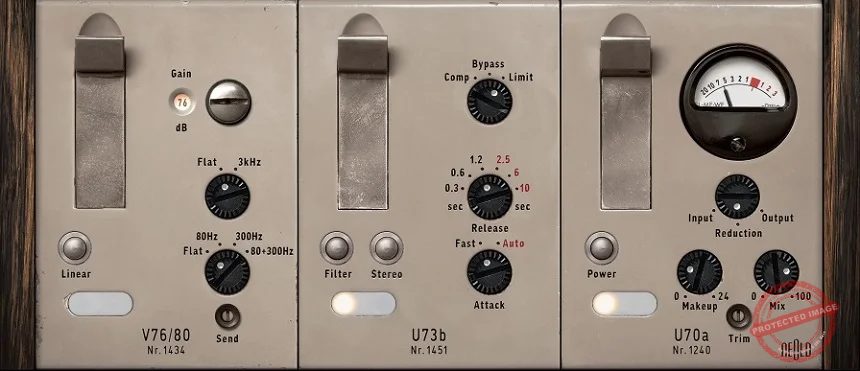
V76U73 comes as an emulation of two legendary vintage units: the 1950s-era V76 tube mic preamp and the U73b variable mu tube compressor/limiter. With a feature-packed design with U70a VU meter, as well as modern enhancement like Mix, Makeup, and Trim controls, it combines warmth, harmonic richness, and smooth dynamics with analog character.
I gotta tell you that I love the GUI of the unit, as it gives you so many controls, such as adjustable gain, low- and high-cut filters, and a unique Send control to tailor how much gain reaches the compressor. Added automatic gain compensation is great for keeping the signal consistent and pushing the gain harder to reach that natural harmonic saturation without clipping. I think when this tool is used on its own, it delivers a tube-driven luster, which works pretty fine for standalone saturation.
I really appreciated that they added a compression section with a Fast and Auto attack mode, six release time settings, and a 100 Hz sidechain filter. It is not the most comprehensive compressor out there, but it really helps when finetuning your tone.
On bass guitars, it gives fatness and sustain, while on lead vocals, it provides a warm, tube-style glow that makes the vocals blend with the mix greatly. I also really liked using it with rock guitars for its detailed sound.
While I think you can use this unit with almost anything, the stars are vocals, bass, and rock guitars. If you are after creamy, dense, supersized tracks, I recommend checking the V76U73, as it brilliantly blends vintage tone with precise control over your sound.
The V76U73 plugin is available in AAX, AU (Mac only), VST2, and VST3 formats and is compatible with MacOS 11 or higher and Windows 10 or higher.
11. KUASSA Efektor Bass Cruncher
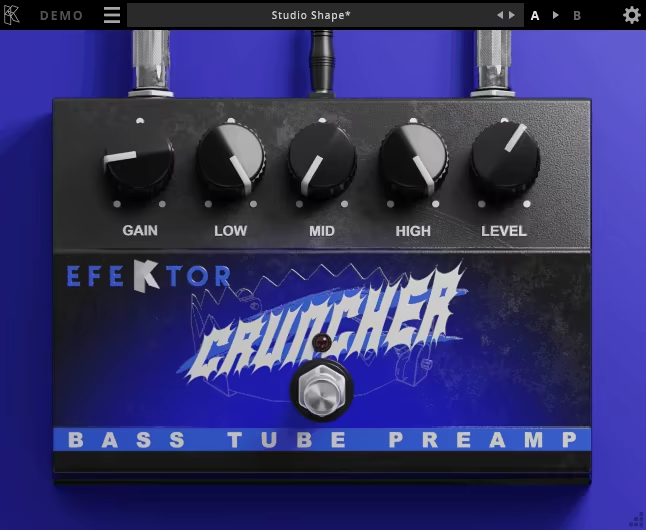
If a dedicated bass preamp is what you are after, here comes the Efektor Bass Cruncher, a tube-driven plugin specially designed to craft your bass instrument tone with richness and crunchiness. It uses a third-generation tube engine, delivering a spectrum of tones from bright, biting highs to warm, growly lows, which is versatile enough to use with many different genres.
Let’s face it! At some level, we all love minimalistic and simplistic plugins with intuitive interfaces, which are focused on getting the job done instead of taking you to complex areas. Efektor Bass Cruncher is just one of them, as it comes with a single-screen straight-forward interface with resizable windows, providing ease of use without hidden features. The controls are Gain, Mid, Low, High, Level, and a bypass button, which are more than enough to create your tone.
I recommend using it mainly on bass guitars as it gives beautiful distorted bass tones and adds bite and solid aggression to low-end frequency instruments. You can also try it with synths, percussion, or even vocals. But remember that the enhancements here are aimed at low ranges. It is great for enhancing the original character of the instrument and adding upper harmonic content for a fuller and richer tone.
In short, the Efektor Bass Cruncher is a good preamp for bass-focused instruments, especially bass guitars, to get that tube-driven warmth and crunch on the low-end frequencies.
Efektor Bass Cruncher comes in VST, VST3, AU, and AAX formats and is compatible with macOS and Windows.
12. Waves Scheps 73
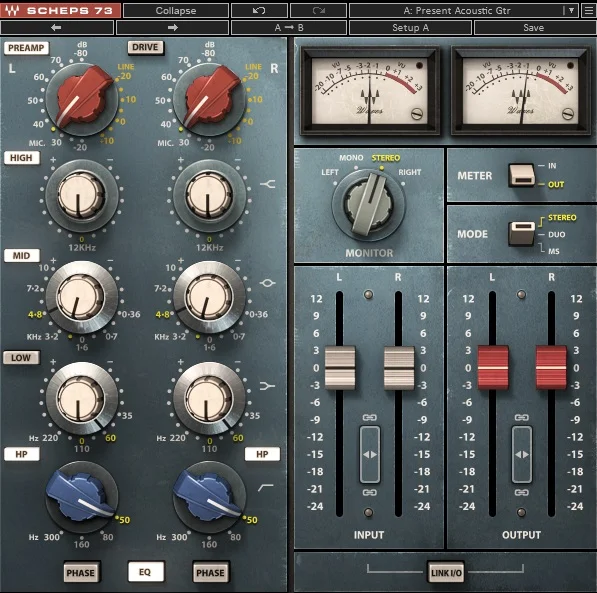
As a Neve 1073 emulation, this unit stands out in a sea of competitors with its vintage authenticity and modern versatility, as it is created with a collaboration with mixer Andrew Scheps, where the name comes from; Scheps 73 was not replicated but enhanced. Added features like M/S processing and a 10kHz mid-band increase the unit’s versatility and bring the Neve warmth but with more control for modern producer workflows.
Here is the deal: I think the plugin is not only great at re-conquering the hardware’s tone, but it also succeeds at bringing you the feel. Its intuitive and musical EQ section, which has a 12kHz high shelf, a mid-band that lets you dial in clarity or punch, and a low shelf that tightens or boosts the bass beautifully, allows you to balance your tone.
Plus, the high-pass filter is always there to tame the low-end rumble, while my favorite part is the preamp section, where everything comes together, allowing the user to drive the Marinair transformer for harmonics and saturation, adding the analog character without any harshness. It also has a Drive knob to dial in some extra grit.
Everything aside, what really impressed me with this unit was the M/S processing, allowing you to sculpt the mid and side channels separately in order to open up new creative ways for your tone. From tweaking the stereo guitar to giving a Rhodes more dimension, it can take responsibility for various tasks.
The GUI has a nice vintage charm, but with so many controls, it can seem overwhelming to some people. That said, it is well organized and comes with nice meters and tags for you to navigate and understand the plugin’s workflow and design. It is a unit with quite a depth, so I suggest take your time and maybe start with the presets to find your way.
It works well with anything from vocals to drums, from subgroups to full mixes, but my favorite was using it on vocals as it adds warm harmonics and depth, making them sit beautifully in the mix. If you love the analog tone but need modern precision, the Scheps 73 is hard to beat.
Scheps 73 is available in VST3, AAX, and AU (Mac only) formats and is compatible with macOS Monterey 12 or higher and Windows 10 or higher.
Extra: Sonimus Burnley 73

Today’s special award goes to Burnley 73, another Neve 1073 emulation with its gain-compensated saturation control that balances input and output levels while injecting that famous preamp character to reach the perfect saturation. As it allows you to focus on tone without worrying about volume shifts, it simplifies the workflow for you with the ability to craft anything from subtle warmth to aggressive drive.
I like that the unit gives you a simplified version of Neve 1073 with its 6-knob design, including a three-band EQ with a flexible midbell with six frequencies, a low shelf with four frequency choices, and a fixed high shelf as well as preamp saturation and high pass filter along with an output level. Each EQ band gives a 16 dB boost or cut, and the bell’s Q gets narrower at a higher gain, which is pretty handy for adding punch to snare drums, for instance, or taming harshness for guitars.
The saturation control is where the magic happens, as it gives subtle fatness to the tone in lower levels, while it can get too boldly present in higher levels, which is great for bass and guitars. The high-pass filter is another handy tool for low-end control.
Although the GUI is pretty basic, it offers a surprisingly good amount of control, as you also have EQ band bypass options, phase invert, and easy frequency selection. I really like this simplicity combined with feature-packed design and think that Burnley 73 does a great job at delivering premium sound and workflow, making it a good choice for producers after the 1073 tone without breaking the band or getting into complex layouts.
Burnley 73 comes in AU (Mac only), VST 2.4, VST 3, AAX, and RTAS formats for Mac OSX 10.6 or newer or Windows XP or newer.
