
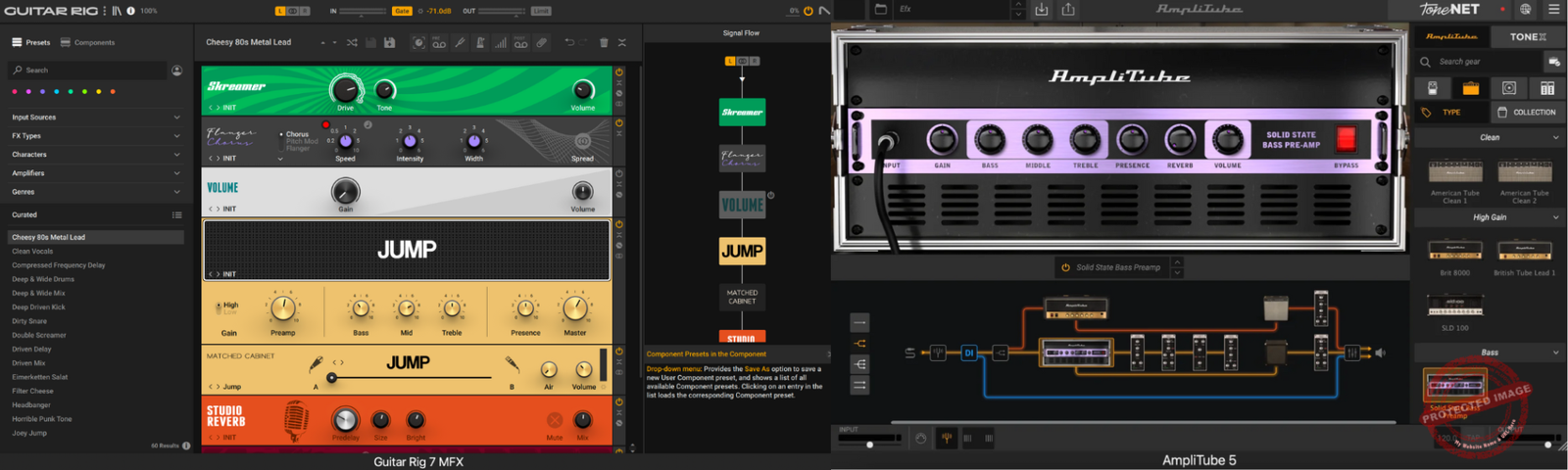
Guitarists gather around! Today, we’re diving into the ultimate showdown: Guitar Rig 7 Pro vs AmpliTube 5!
These two heavyweights of the amp sim world promise to take your guitar tone to places you didn’t even know existed. But which one’s the real MVP for your setup?
Guitar Rig 7 Pro, the latest from Native Instruments, comes in swinging with its modular design and endless creative options. I always think of it like a mad scientist of virtual rigs, as it is always experimental, versatile, and offers wild approaches that you wouldn’t take otherwise.
Meanwhile, AmpliTube 5 comes with years of experience like a polished rockstar, as it is the definition of plug-and-play with its authenticity and flexibility, inviting you to create anything from pristine cleans to crunchy, face-melting distortion.
I’ve been playing around with both units and let me tell you, each one comes with its advantages and disadvantages. Both are pretty great for most cases, but subtle nuances decide which one is your guy. So, let’s strap in, turn it up, and get into it!
Features
| Feature | Guitar Rig 7 Pro | AmpliTube 5 |
| Platform | Mac, PC (Standalone, VST3, AU, AAX) | Mac, PC (Standalone, VST3, AU, AAX) |
| Standalone Mode | Yes | Yes |
| User Interface | Virtual rack design | Traditional signal chain with skeuomorphic visuals |
| Number of Amps | 26 amps (4 new ICM amps) | 35 amps |
| Cabinet Simulation | Impulse Response (IR) Loader with curated IRs | VIR technology with 2,400 IRs per cabinet |
| Effects | 115 effects | 183 effects |
| Presets | 100+ artist presets | Artist and branded presets (e.g., Fender, Mesa Boogie) |
| Looping Features | Loop Machine Pro for live use and creativity | 8-track looper (in standalone mode) |
| Performance Features | Macro controls, split mix, crossover, M/S split | Advanced signal routing with 57 simultaneous FX |
| Modulation Effects | Lo-fi effects (e.g., Tape Wobble, Noise Machine) | Traditional and modern modulation options |
| CPU Usage | Moderate to heavy | Moderate (scales with complexity) |
| Standout Features | Intelligent Circuit Modeling (ICM), artist presets, lo-fi effects | VIR technology, branded gear, artist signature presets |
Sound and Character: Authenticity Meets Flexibility
When it comes to sound, both Guitar Rig 7 Pro and AmpliTube 5 excel in their own ways. Both of them have their unique approaches to sonic authenticity and versatility.
- Guitar Rig 7 Pro
Guitar Rig 7 Pro is great in terms of tonal flexibility and experimental options. The new Intelligent Circuit Modeling (ICM) amps sound great, bringing dynamic realism to every note.
Whether you’re running clean tones through the Reverb Delight (a stunning Fender ‘65 Reverb emulation) or dialing in gritty British vibes with the AC Box XV, these amps feel responsive and alive. Its sonic quality is pretty dynamic and natural, bringing a great range of tones for any genre, from high-gain textures to shimmering cleans.
But the real perk here is that Guitar Rig’s versatility reaches many genres and has many design applications. It has lo-fi effects such as Tape Wobble, Noise Machine, and Kolor for experimental uses, while its amp models offer great tones for more traditional guitarists.

From ambient soundscapes to quirky, textured layers, this unit can create anything. It is not just for guitars, but it works great with other instruments, too, such as vocals, synths, drums, and even full mixes.
For sonic choices, Guitar Rig’s modular design means you can build and rebuild signal chains effortlessly. Its signal-splitting tools, including mid/side and crossover options, enable the independent processing of different frequencies.
- AmpliTube 5
The star of the show in AmpliTube 5 is the tonal realism. It is powered by VIR (Volumetric Impulse Response) technology that captures the subtle details of iconic amps, cabs, and their interactions, from mic placement to room acoustics.
The result is a sound that feels like you’re playing through a perfectly mic’d amp in a high-end studio. You can virtually “move” microphones around cabinets, swap speakers, and even adjust room reflections for a highly personalized tone.
AmpliTube’s library is massive, offering 57 amps, 100+ cabinets, and over 435 effects (in the MAX version) and 35 amps and 28 cabs with over 180 effects in the Standard version.
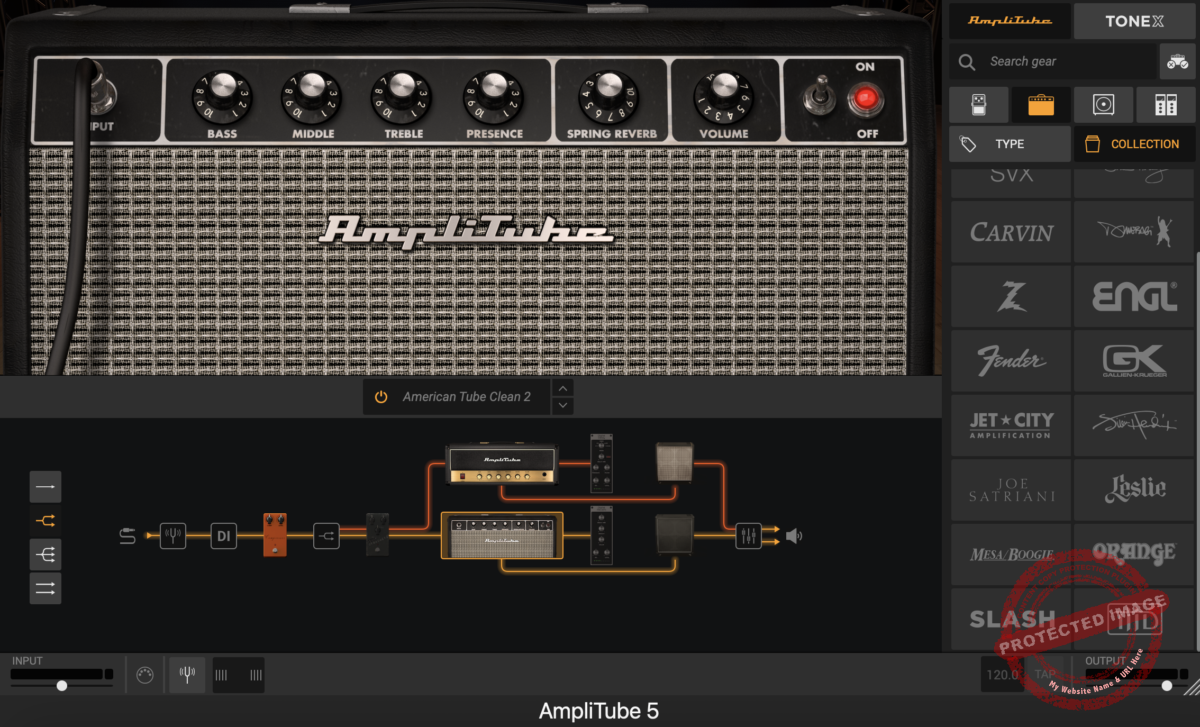
Another great aspect is that the unit comes with branded gear like Fender, Mesa Boogie, and Orange, along with great artist presets of iconic guitarists like Slash and Jimi Hendrix to get closer to their tonal realms. You can immediately access legendary tones in music history.
The studio rack effects derived from IK’s T-RackS suite add even more polish, making AmpliTube not just a guitar tool but a versatile production suite for mixing and mastering.
Where AmpliTube shines in sound quality, it also excels in user-friendly customization. Its drag-and-drop interface makes building signal chains intuitive and features like stereo signal routing and 8-track recording in standalone mode give you incredible flexibility.
- Comparison
Guitar Rig 7 Pro offers a broader canvas for creativity with its experimental effects, modular routing, and genre-spanning flexibility. If you like pushing boundaries and creating unique tones, this is your go-to tool. It is ideal for the experimental musician or producer looking for versatility and out-of-the-box creativity.
AmpliTube 5 is all about authenticity and precision. Its VIR technology and a vast library of branded gear make it perfect for guitarists seeking lifelike emulations of legendary amps and effects. So, if you are a tone purist who demands the highest level of authenticity, I recommend this one over Guitar Rig.
Features and Interface
Amp Modeling Technology
Guitar Rig 7 Pro leverages Intelligent Circuit Modeling (ICM), which captures the subtle dynamics of amps with remarkable accuracy. The new ICM amps, like the Super Fast 100 and Reverb Delight, offer dynamic responses that feel like you’re interacting with real analog gear.

AmpliTube 5, on the other hand, excels in realism, pushing the limits of authenticity to new levels with its Volumetric Impulse Response (VIR) technology. This tech is an innovative approach that perfectly mimics the interactions between different amp, cab, and mic placement options.
With 600 IRs per speaker, this tool offers quite a bit of depth, versatility, and accuracy. I love that it even allows you to fine-tune the mic positions, distance, and axis for realism and flexibility. And the nuances really make a difference, so these are not just empty promises. If you like to play with details for higher realism, especially for recording scenarios, you will love this unit, as precision is key for it.
While both excel in delivering lifelike amp modeling, AmpliTube 5 edges ahead for users who demand ultimate authenticity, while Guitar Rig 7 Pro offers a more creative, versatile experience.
Effects Library
If you’re into wild, experimental sounds, Guitar Rig 7 Pro is your playground.
For those who like wild and experimental sounds, Guitar Rig 7 Pro is packed with over 115 effects that go way beyond the basics.
Fancy a bit of Tape Wobble for that warbly, lo-fi vibe? Or maybe the Noise Machine to add some gritty textures? How about Kolor for some character-driven distortion? It’s all there. The coolest part is how you can stack these effects in ways that defy convention, making every sound uniquely yours. It’s not just a guitar plugin, as it’s a creativity booster.

Meanwhile, AmpliTube 5 takes the sheer quantity route, and boy, does it deliver. With over 435 effects in the MAX version (even the Standard edition gives you more than 180 in total!), you’ve got every iconic sound you could dream of. Branded pedals and artist-specific gear? Check.
Fender, Mesa Boogie, Slash? Double check. Everything’s neatly organized, so you can find what you need fast, whether you’re on stage or in the studio. If you’re a tone purist who wants to nail that classic sound, this is your sweet spot.
In a nutshell, AmpliTube 5 is all about quantity and authenticity, while Guitar Rig 7 Pro is the go-to if you love exploring uncharted sonic territory.
Signal Routing and Management
Let’s talk signal chains because this is where Guitar Rig 7 Pro absolutely flexes. With advanced routing options like mid/side processing and crossover splitting, you’re not just playing with sound; you’re sculpting it.
Imagine distorting only the low end while keeping the highs pristine and clear, yep, that’s possible. The new sidebar makes all this manageable, too, so you’re not lost in a web of settings. It’s perfect for anyone who loves experimenting and pushing the boundaries.

AmpliTube 5, on the other hand, keeps it simple but effective. Its wet-dry-wet routing system is easy to use, and the drag-and-drop editor feels like second nature. Plus, the dedicated mixer window is a dream for anyone fine-tuning their cabinet, room, and DI tones. You can get super polished results without needing an advanced degree in audio engineering.
If you’re all about precision and clean workflows, AmpliTube’s got you. But if you’re a sound design nerd who loves tweaking every detail, Guitar Rig 7 Pro is where it’s at.
Standalone Tools
For live performers and improvisers, Guitar Rig 7 Pro brings the magic with its Loop Machine Pro. This tool is a powerhouse for live looping, layering ideas, building soundscapes, and turning a simple riff into a one-person symphony. It’s perfect for those spontaneous moments of creativity when you just need to let loose.
Furthermore, the app offers a metronome, tuner, and extras for more convenience.
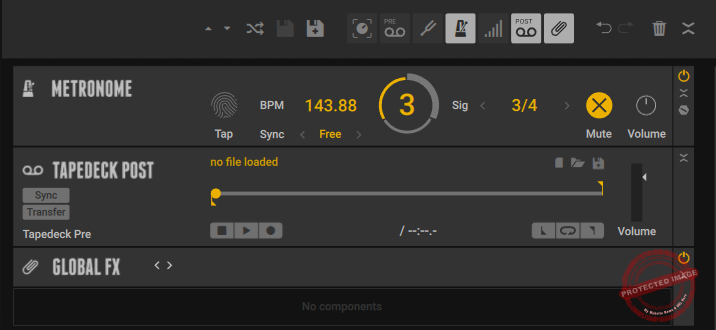
Now, AmpliTube 5 plays a different game with its built-in 8-track recorder. This is your one-stop solution for recording demos, hashing out songwriting ideas, or even setting up live performance tracks. It’s simple to use and gives you just enough DAW-like functionality to capture your creativity without needing extra software.
So, if you’re all about live looping and on-the-fly creativity, Guitar Rig’s your guy. If recording and layering tracks are more your thing, AmpliTube’s got your back.
Presets and Customization
Sometimes, you get lazy or just want a killer preset to get started, and Guitar Rig 7 Pro delivers it with over 100 presets designed by artists like Mike Shinoda and Serj Tankian. These presets thrive in quality and quantity as they are creative and genre-spanning setups for inspiration.

AmpliTube 5, meanwhile, has a library packed with presets that are almost intimidating. You’ve got genre-based setups, artist packs (Hendrix and Slash fans, rejoice), and branded gear from legends like Fender and Orange. The tagging system is super handy, letting you zero in on exactly what you need without wasting time scrolling.
This comes down to personal taste. For me, Guitar Rig’s presets are more adventurous, which is great for experimenting and exploring, while AmpliTube presets are ideal for those who want iconic tones fast.
Interface
The interfaces of Guitar Rig 7 Pro and AmpliTube 5 reflect their underlying philosophies.
Guitar Rig 7 Pro’s modular, rack-based design encourages experimentation. The new sidebar view provides an organized way to visualize your signal chain, while the drag-and-drop functionality makes building and adjusting setups feel effortless.

It’s an interface that invites creativity, allowing you to explore complex signal chains without feeling overwhelmed. With its more intuitive design, it offers a simpler workflow thanks to its virtual rack design.
AmpliTube 5 takes a more traditional approach with its pedalboard-style layout, which mimics the look and feel of original physical rigs. It is great for those who are after realistic aesthetics.

This familiarity makes it an excellent choice for players who are used to analog setups. The drag-and-drop editor is highly intuitive, and the updated mixer window adds a layer of precision that’s invaluable for studio work.
Guitar Rig 7 Pro excels in flexibility, ease of use, and creativity, while AmpliTube 5’s realistic interface is perfect for traditionalists and tone purists.
Performance
Compatibility
Guitar Rig 7 Pro and AmpliTube 5 come in VST3, AU, and AAX formats for macOS and Windows platforms.
They also have standalone applications, making them versatile for both DAW-based workflows and live setups.
CPU Use
Talking about CPU use, AmpliTube 5 is a more resource-friendly application. I have tried it with complex setups involving multiple amps, cabinets, and effects, but it still did not create any problems. Its streamlined workflow and VIR tech find the perfect balance between performance and resource use.
Guitar Rig 7 Pro is slightly more CPU-hungry with its highly flexible and modular design, especially when using advanced routing features like crossover splits or stacking multiple effects chains.
In Practice
Live Performance
In live performances, Guitar Rig 7 Pro is like having a mad scientist’s lab at your feet. The Loop Machine Pro is the star of the show here as it’s perfect for layering riffs, stacking loops, and pulling off those solo “how-is-this-just-one-person?” moments.
Add a MIDI foot controller, and suddenly, you’re an orchestra of one. Plus, those advanced routing options? You can split your sound, process the lows with a bass fuzz, keep the highs pristine, and wow the crowd with something fresh every night. So, this is a great unit for those who like the unpredictability.

On the other corner, we have the AmpliTube 5 with its reliable and authentic tones approach. It has a more straightforward design when setting you up for a gig without making things complicated.
The tones are rock-solid, and because it focuses on nailing the sound of legendary amps, your audience will feel like they’re front-row at a classic rock concert. It’s not as flashy as Guitar Rig’s trickery, but sometimes, simple and dependable wins the day.
If you’re the experiment-every-gig type, Guitar Rig 7 Pro is your jam. If you just want to sound killer without reinventing the wheel, AmpliTube 5 has your back.
Mixing and Production
For mixing, Guitar Rig 7 Pro is like your wildcard friend, the one who brings a drum machine to a campfire jam and somehow makes it work. It’s not just for guitars. You can throw synths, vocals, or even drum loops into it, and it churns out something completely unique.
It is so versatile that pads that sound like they’ve been warped through a VHS machine or vocals that shimmer and wobble like they’re floating in space are easy-peasy for it. So, for different projects like electronic or ambient, where breaking the rules is half the fun, Guitar Rig is a total vibe, besides the traditional guitar uses.

Meanwhile, AmpliTube 5 is a reliable studio assistant who always shows up on time and knows exactly where the coffee is. It’s built for precision.
The VIR mic tools let you fine-tune your cabinet tones to perfection, and the T-RackS effects are like having a mixing desk at your fingertips. It’s the kind of plugin you turn to when you need to make a guitar or bass sit beautifully in a mix without any fuss. Perfect for rock, metal, blues, or any genre where authenticity rules.
For mixing and production, Guitar Rig 7 Pro is your go-to for creative chaos, while AmpliTube 5 is all about getting pro results with no surprises.
Home Recording and Practice
At home, AmpliTube 5 feels like jamming with your dream rig but without angry neighbors banging on the walls. The 8-track recorder gets super handy when you have the inspiration and need to record immediately.
With the unit, you can layer tracks, tweak tones, and turn a simple riff into a full song, all without firing up your DAW. The tones thrive so much in realism that they can make you forget you are using an application.

Guitar Rig 7 Pro, though, is like having a toy store of sound at your fingertips. The Loop Machine Pro is perfect for building ideas on the fly, and its compatibility with vocals, synths, and more makes it a multi-instrumentalist’s dream.
You can take a simple guitar riff, throw in some Noise Machine textures, and layer it with a vocal processed through Tape Wobble for something totally out there. It’s a bit more hands-on, though, so if you’re just looking to jam without overthinking, it might feel like too much.
For home recording and practice, AmpliTube 5 is the chill option that lets you focus on playing, while Guitar Rig 7 Pro is perfect if you love experimenting and turning practice sessions into mini-productions.
Conclusion
Choosing between Guitar Rig 7 Pro and AmpliTube 5, all boils down to personal preference and what you prioritize in your guitar projects.
Guitar Rig 7 Pro is your go-to for creativity and experimentation. Its modular design, advanced routing, and multi-instrument capabilities make it a playground for sound designers and musicians who love pushing boundaries.
On the other hand, AmpliTube 5 delivers unmatched realism and simplicity, offering studio-ready tones that are perfect for traditional guitarists and producers.
If you’re an adventurous player or producer who thrives on building unique soundscapes, Guitar Rig 7 Pro will inspire you with its flexibility and innovative tools. But if you prefer the authenticity of iconic amps and effects paired with a hassle-free setup, AmpliTube 5 is the clear winner for you.
