Gather bass lovers as we explore how Neural DSP Parallax X and Darkglass Ultra stack up when it comes to crafting the ultimate bass tone!
Bassheads, this one is for you! Let’s talk about taking your low-end game to new realms! Today, we will create a head-to-head smackdown between two powerhouse plugins, Neural DSP Parallax X and Darkglass Ultra. From clean and modern articulation to gritty and growling saturation, these two units are making waves in the bass world, and for a good reason.
Parallax X is like your ultimate all-in-one tone factory, built for bassists who want to conquer parallel processing without the headache of dual rigs. It’s loaded with tools to craft everything from tight, articulate mids to face-melting distortion, all wrapped up in a sleek, intuitive interface.
On the other corner, we have Darkglass Ultra, which faithfully emulates the iconic B7K Ultra and Vintage Ultra preamps. This one is all about delivering that renowned Darkglass punch with high flexibility for shaping the tone.
Tech-savvy producers, gigging bassists, or anyone looking to create a striking bass sound, today I will help you figure out which of these bad boys can suit your plugin collection better. Ready to rumble? Let’s break it down!
Features
| Feature | Neural DSP Parallax X | Darkglass Ultra |
| Focus | Parallel bass processing for powerful tone design | Emulation of Vintage and B7K Ultra bass preamps |
| Low-End Control | Dedicated low-end compression for massive foundation | Grunt Switch for low-frequency saturation control |
| Distortion | Separate mid and high band distortion with tube modeling | Overdrive saturation with Drive and Blend controls |
| Equalizer | 6-band graphic EQ for tone fine-tuning | 4-band EQ with switchable mids and treble adjustments |
| Cabinet Simulation | 6 virtual microphones with flexible positioning | 7 virtual microphones plus a sub-kick for extra low end |
| Extras | Transpose feature (+/- 12 semitones), tuner, metronome | Tweeter control for edge/attack, blend clean/overdriven tones |
| Standalone App | Yes, for quick practice and live use | Yes, for plug-and-play practice and live scenarios |
Sound and Character
Sound and character are the most important factors when it comes to choice. So, let’s compare these plugins from this perspective.
- Parallax X
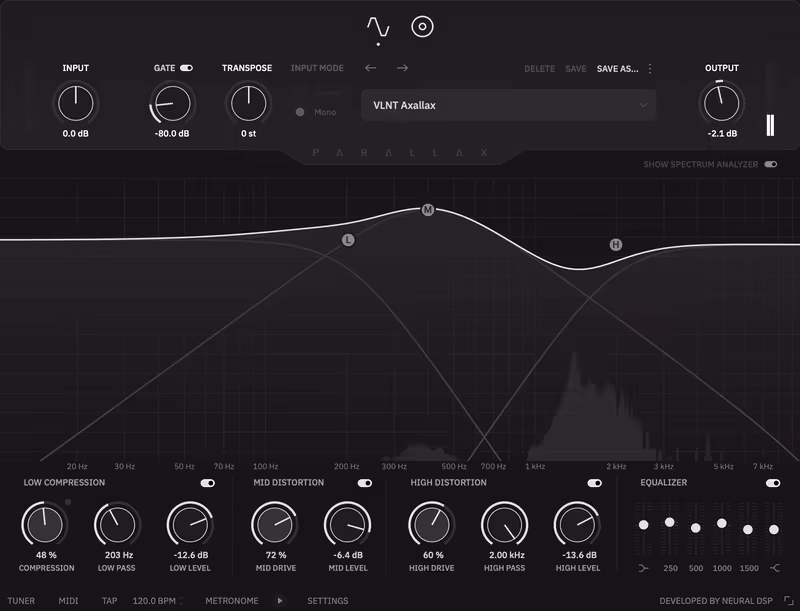
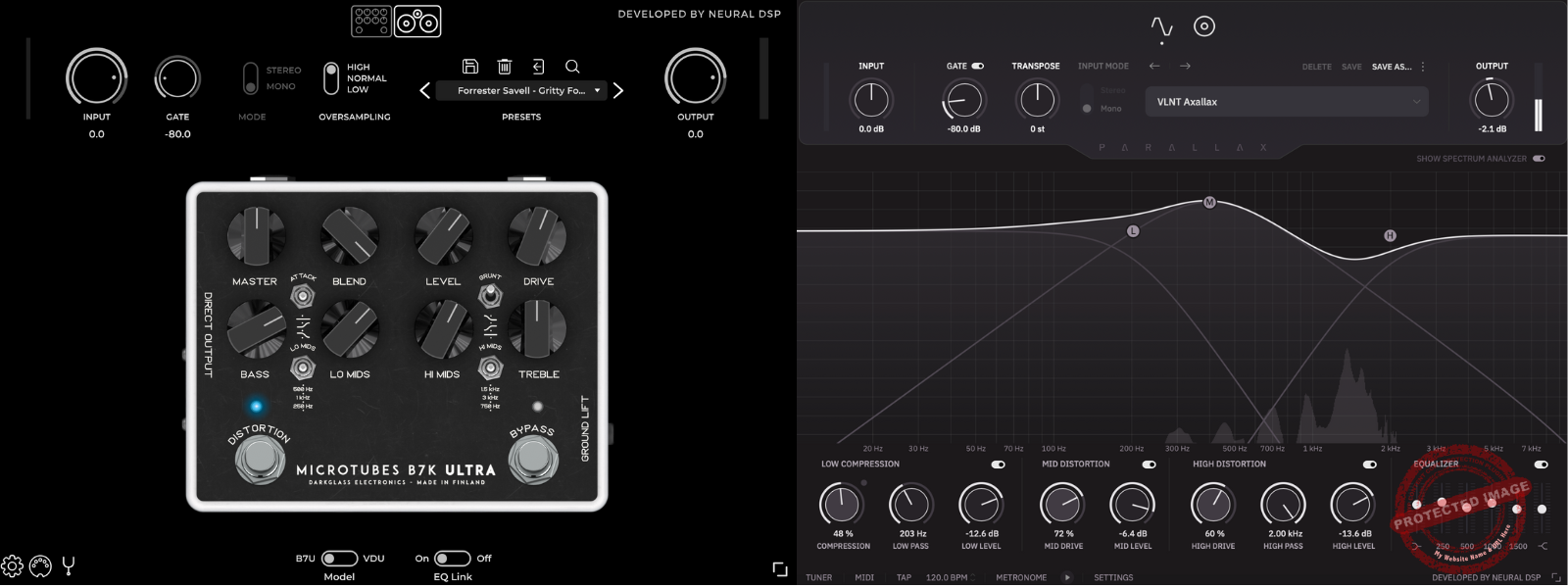
The Neural DSP Parallax X is a powerhouse for modern bass processing, bringing precision and versatility to the forefront.
The first to mention is the unit’s 3-band crossover system with low, mid, and high bands, which allows for specialized crafting. The low compression is great with serious punch without the muddiness. The mid and high distortion add a sweet tube-like distortion, which you can adjust anywhere from subtle warmth to full-on aggression.
The 6-band EQ of the plugin and cab sim are handy for extra finetuning, increasing the tonal versatility.
I found the Parallax X to be pretty amazing for genres like metal and djent, where you need to add clarity and aggression at the same time. But, I must say it is more than a one trick pony, as with subtle settings, it sounds pretty good for funk or pop bass lines. It makes the bass track pop out in the mix without overpowering the other elements.
I also enjoyed using the transpose feature as it makes the plugin super useful for practice, live gigs and studio work along with teh standalone app. Whether you’re crafting heavy bass tones or experimenting with layered synth bass, Parallax X has the tools to help you conquer.
- Darkglass Ultra
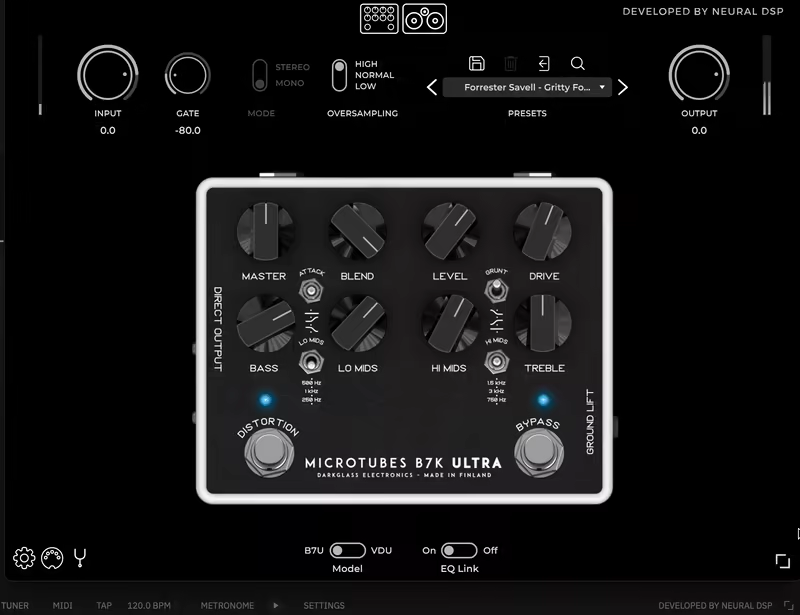
The Darkglass plugin brings the iconic tones of the B7K Ultra and Vintage Ultra preamps to your digital studio.
If you are familiar with the bass preamps, you may know that these ones are famous for their iconic analog warmth and gritty overdrive. Also, the plugins shine with their successful emulations of the physical hardware, as they are really capable of blending clean and saturated signals.
I think one of the greatest tonal features here is that the unit allows you to sculpt the low and high ends with the Grunt and Attack controls, while the 4-band EQ offers surgical control over your tone.
Darkglass offers pretty fantastic tones for metal, punk, and hard rock bass with its fat, aggressive tones. It also serves well for funk and indie realms as, with some tweak it can reach tight, punchy lines as well as warm vintage growls.
The cab sim module also gives good depth and richness and the sub-kick, as one of my favorite features, is great for low-end thump without muddying the waters. But this is especially true for those who want analog aggressive vibes in the first place.
- Direct Comparison
Well, they both excel in their own offerings, and their powers serve different needs.
Parallel X features a more modern sound and is great for bassists after precision and versatility, as it has clean and highly defined tones, which is ideal for generals like metal, prog, and dense mixes.
Its multi-band distortion and compression tools give pretty great control over your sound, making it a handy unit for creating articulate and unique basslines. But, it comes with some limits. In my experience, the mids and highs can feel overly distorted, even in the lowest settings. So, it needs long tweaks for cleaner tones.
On the other corner, Darkglass is very successful with analog warmth and punch, with its fuzzier and richer tones. The initial sound you get from the plugin is super satisfying for metal and the easy controls make tonal shaping fast and easy.
So, I can say Darkglass is aimed at those who want a classic, gritty sound with minimal fuss. It is great for combining distorted signals, offering richly distorted tones. But, for versatiltiy and differnet tonal approaches I think Parallax X thrives much better.
So, to summarize, Parallax is great for versatility, modern tones and tone-shaping tools, while Darkglass shines in simplicity, character, and tasty distortion. Ultimately, the choice boils down to what you need: precise modern tone-sculpting or quick and rich analog-inspired tones.
Features and Interface
Here I will take a look at some of the key features of both plugins to compare them from the workflow and versatility perspective.
- Multiband Processing
Parallax X features a 3-band crossover system for low-end compression and mid-high distortion for more control, while Darkglass does not feature a multi-band system, but a powerful clean-to-saturated signal blend, allowing for a simpler workflow but less versatility.
- Cab Simulation

These two plugins are among my favorites in terms of cab simulation. Parallax X comes with 6 virtual mics and offers the ability to load custom IRs, highlighting the mid and high bands for tone shaping with detail. Darkglass has a more straightforward approach as it has 7 mic models and a sub-kick feature, for a deeper and warmer sound.
- Versatility

Parallax has advanced features like a pitch transposer, metronome, and standalone app, which is great for studio, live, and practice uses. Darkglass Ultra, while simpler, excels in versatility by switching between the B7K and Vintage Ultra, covering a wide tonal range with minimal effort.
- Interface
The Parallax X interface is sleek and detailed, with drag-and-drop controls and multiple view modes for fine-tuning. Darkglass Ultra, on the other hand, keeps things simple and hardware-inspired, ensuring an intuitive experience for users seeking quick results. Both are easy to navigate but cater to slightly different workflows.
Performance
When it comes to performance, both Neural DSP Parallax X and Darkglass Ultra pack a punch, but their efficiency and compatibility play key roles in choosing the right fit for your workflow.
- Compatibility
Parallax X and Darkglass Ultra come in VST3, AU, and AAX formats for Mac and Windows systems. Plus, both units include standalone apps, which is great for live uses and quick setups.
- CPU Use
Parallax X is slightly heavier on the CPU due to its multiband processing and advanced features like pitch shifting and cab simulation. Darkglass Ultra offers a lighter footprint, making it a better choice for projects where CPU efficiency is critical. Both plugins perform well, but Parallax X demands more power for its detailed processing capabilities.
In Practice
Let’s see how these units match up in different use scenarios.
- Sculpting Metal Bass Tones

As these are emulations of famous metal hardware, the first criterion is on sculpting metal bass tones, and I can honestly say both of the units thrive in that sense but they shine in different ways.
Parallax X offers higher flexibility with its multi-band processing feature, allowing you to compress lows for tonal thunderous foundation while adding sweet saturation to mids and highs for more aggressiveness.
The cab simulation and 6-band EQ offer higher precision, making the unit suitable for even different tones and cutting the tones through dense metal mixes. For modern metal and djent players, the ability to control the distortion across different frequency ranges is a real game changer.
Darkglass, on the other side, has a more straightforward approach. As it is a B7K Ultra and Vintage Ultra emulation, it offers more classic and saturated metal bass tones with punch and definition. The plugin’s grun and attack switches are great for low-end heft and treble aggression, offering quick fine-tuning and mix-ready instant results.
While Parallax X excels in versatility and modern metal tones, Darkglass Ultra is the go-to for plug-and-play classic metal bass tones.
- Live Performances and Practice

When it comes to live use, Parallax X is a better choice with its standalone mode and robust cab simulation. Its transpose function is super handy, allowing you to adapt to alternate tuning without changing the instrument.
Plus, the built-in tuner and metronome make it a super solid all-in-one tool for stage and rehearsal use. Also, I like that it has the customizable cab and mic settings making sure that the processed sound translates well in live setups.
Although Darkglass Ultra has a simpler approach, it also offers a handy practical standalone mode. Its user-friendly interface is great for quick adjustments, and the high-quality cab simulation with its sub-kick and mic placement options is excellent for a mix-ready sound without extensive tweaking.
In the end, Parallax X might appeal more to players who want extensive control in live scenarios, Darkglass Ultra’s simplicity makes it ideal for those who value ease of use and reliability on stage.
- Studio Workflow and Mixing

In studio settings, Parallax X becomes a powerful tool for bass production. Its multi-band processing and cab simulation make it ideal for layering tracks, balancing low-end weight with high-end articulation.
The plugin’s ability to add subtle distortion or full-on grit allows producers to shape bass tones to fit any genre, from clean pop basslines to aggressive rock tones. The ability to load custom IRs further enhances its versatility in-studio workflows.
Darkglass Ultra also shines in the studio, especially for those seeking classic analog-inspired bass tones. Its overdrive options, combined with a flexible EQ, make it easy to achieve tones that sit well in a mix without additional processing. The ability to switch between B7K Ultra and Vintage Ultra models gives producers quick access to a range of tonal colors.
While Parallax X offers more detailed customization, Darkglass Ultra provides a faster path to polished, musical bass tracks.
Conclusion
When it comes to bass tone processing, Parallax X and Darkglass Ultra offer distinct strengths tailored to different needs.
Parallax X shines with its advanced multiband processing, giving users unmatched control over low-end compression, midrange articulation, and high-end saturation.
Its flexible cab simulations and added features like pitch transposition and a built-in metronome make it a versatile tool for both studio and live setups. It’s the choice for those who want to dive deep into crafting complex and highly personalized bass tones.
On the other side, Darkglass Ultra delivers classic bass tones with simplicity and reliability. Its emulations of the legendary B7K Ultra and Vintage Ultra preamps provide a plug-and-play solution for achieving mix-ready sounds, especially for metal and rock. With its intuitive interface and excellent cab simulation, it’s perfect for bassists who want results fast without sacrificing quality.
Ultimately, the choice between these two plugins depends on whether you prioritize detailed control and versatility, Parallax X, or straightforward, high-quality tone shaping, Darkglass Ultra.
